How do you hide a 60,000 pound, 40-foot long whale? Dress it up like a different species and then hide it in the Gulf of America!
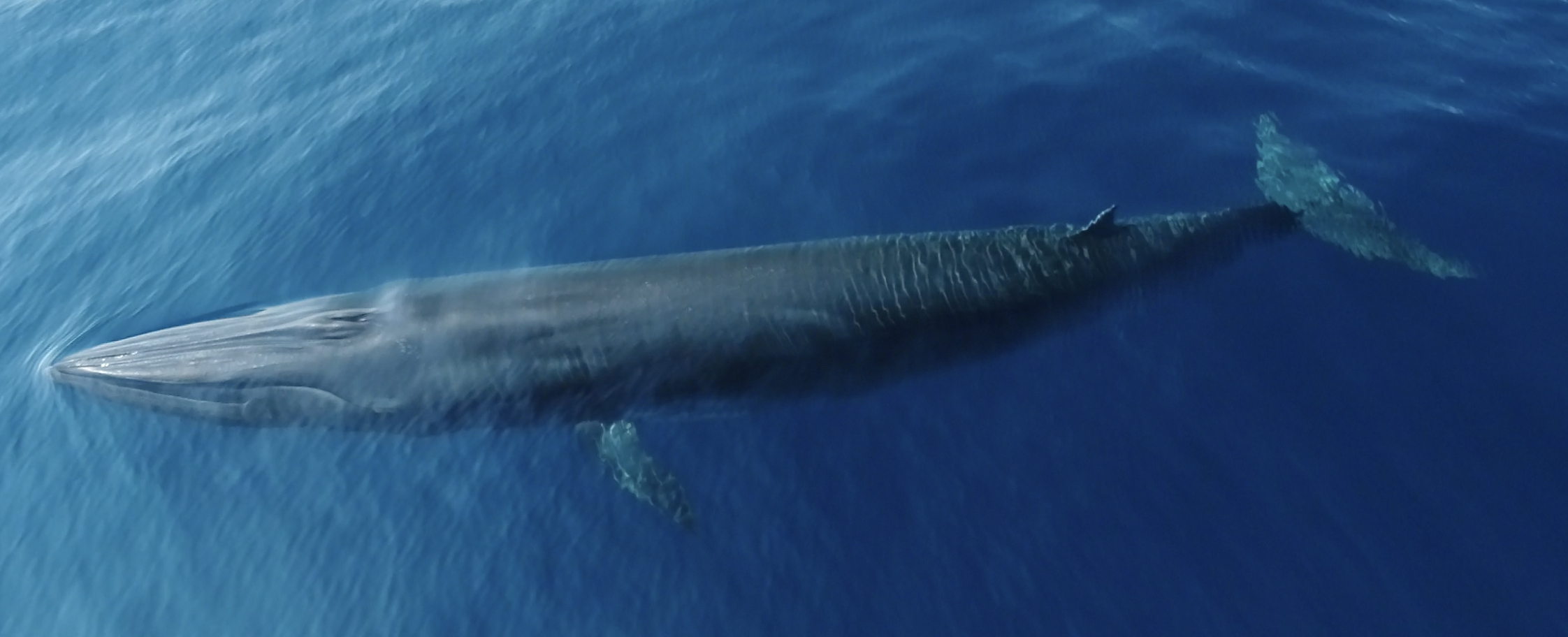
A Rice’s whale photographed using a drone. Photo Courtesy NOAA CR NOAA Fisheries Ocean Alliance (Permit #21938)
Meet the Rice’s whale (Balaenoptera ricei), “discovered” in 2021. For decades, scientists knew these whales lived in the Gulf. But, from the rare observations, it was assumed to be a smaller Bryde’s whale (pronounced: broodus).
In 2014, scientists took a closer look at a skull found in 1954. It was different than a Bryde’s. Then DNA cinched the deal. In 2021, biologists introduced the world to a new species, the Rice’s whale!
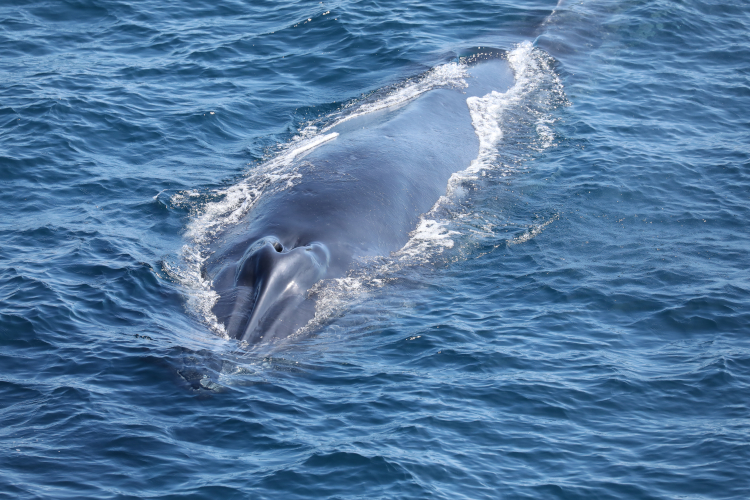
A Rice’s whale’s three ridges in front of its blowhole. Photo courtesy NOAA Fisheries/Paula Olson (Permit #21938)
Like its ocean doppelganger the Bryde’s whale, Rice’s whales have a sleek body, three prominent ridges in front of their blowhole, and a hooked or curved dorsal fin. However, Rice’s whales are smaller and seem to have a different diet and hunting depth than Bryde’s. They also have unique vocalizations. Scientists use the whale’s vocals to help track them.
The head of a Rice’s whale is a quarter of its body length. Baleen hangs from the upper jaw of its giant mouth. Like Bryde’s, blue, and humpback whales, Rice’s have throat grooves that expand when they fill their mouth with food and water. Once the whale has a massive mouthful of water and food, prey is trapped by the baleen as water is forced out between the baleen plates.
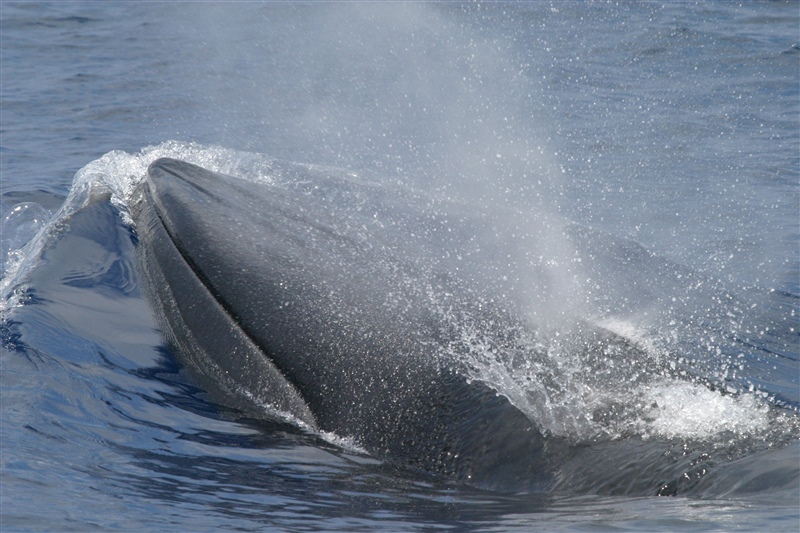
Rices Whale but noted as GOMexico Bryde’s Rice’s Whale in Gulf of Mexico Photo credit Wayne Hoggard Courtesy NOAA NMFS/SEFSC
Like other baleen whales, they have two blowholes on top of their head.
Rice’s whales are often found at depths between 328 to 1,312 feet (100-400 m), possibly diving deep to hunt schooling fish. At night, they hang out within 50 feet of the surface. This behavior makes them vulnerable to boat strikes.
Currently, experts estimate there are about 50, maybe up to 100 Rice’s whales living in the Gulf of America. Further research will help scientists discover if Rice’s whales live beyond the Gulf. And, even more urgently, biologists and citizens are working to find ways to protect these newly discovered, and, unfortunately, already endangered whales.
So, if you think there’s nothing new to be discovered in the ocean, remember a whale as big as a Rice’s whale hid in plain sight.
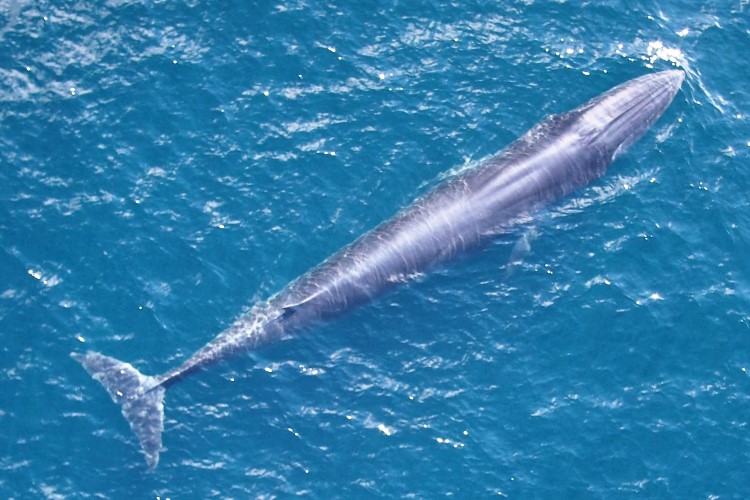
Rice’s whales can be 40 feet long. It took a an unmanned aircraft (during a scientific research project) to capture this giant whale’s entire body! Photo courtesy NOAA Fisheries/Lisa Conger/Beth Josephson (Permit #21938)
More faux-Brydes whales? In 2003, scientists identified another whale disguised as a Bryde’s whale in the Sea of Japan. Until they looked at DNA and its skeletal structure and discovered it, too, is a completely different species now called Omura’s whale (Balaenoptera omurai). With a new name, the search was on to find out more. Omura’s whales have been found in the eastern Indo-Pacific, western Indian Ocean, and the Atlantic. Omura’s whales are about 33 to 38 feet long.
Back to WhaleTimes’ Hagfish Day

About WhaleTimes, Inc.: WhaleTimes creates a connection between the ocean, ocean research, the researchers, and students through formal and informal education programs. This connection ignites a passion for the ocean, inspires students to consider marine science as a career, and empowers kids to protect the ocean. WhaleTimes, Inc. is a 501(c)(3) nonprofit marine science education organization.
©WhaleTimes, Inc.