Great frigatebird (Frigata minor)

This seabird is as comfortable in the air as you binge watching your favorite shows in a comfy chair. It even sleeps in the air!
The beauty and grace of the frigatebird shines when it’s in the air. It soars. It glides. Once in the while it even flaps its giant wings. Frigatebirds have a giant wingspan ranging in size from 6.7 to 7.5 ft. wide!
These seabirds rarely land touch the ground unless they are nesting. This elegant high flying acrobat loses all its cool points on land. The huge body, giant wings, long tail, and short legs help it fly. But not walk. Frigatebirds cannot walk on their two legs like other two-legged animals like you or a chicken. It hops from one leg to the other.
These oceanic birds are not water lovers. They do not swim, dive (in the water), or float on the surface. Their feathers and body are not designed for water.
Frigatebirds snatch fish, sea turtle hatchlings, and other treats from the surface of the water. Flying fish are a favorite food. Frigatebirds are also notorious for stealing food from other seabirds. Kind of a bully of the sky, a frigatebird chases, pesters, even pulls the tail of other seabirds. To stop the harassment, the other bird spits up (yes that means vomits) its freshly swallowed fish. Then the frigate bird catches and eats the falling partically digested food. Sometimes other frigate birds harass that frigate bird, who spits up the fish. The poor (now long dead) fish is eaten and barfed multiple times until a winner gets to keep it down. Frigate birds hover over seabird nesting colonies. They stalk incoming parents that are returning with food for their chicks.
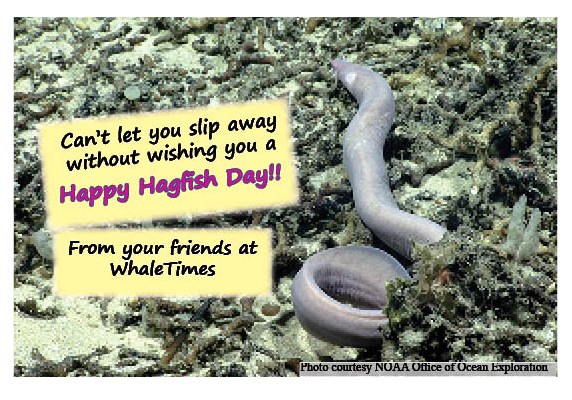 Back to WhaleTimes Hagfish Day!
About WhaleTimes, Inc.: WhaleTimes creates a connection between the ocean, ocean research, the researchers, and students through formal and informal education programs. This connection ignites a passion for the ocean, inspires students to consider marine science as a career, and empowers kids to protect the ocean. WhaleTimes, Inc. is a 501(c)(3) nonprofit marine science education organization.
© WhaleTimes, Inc.