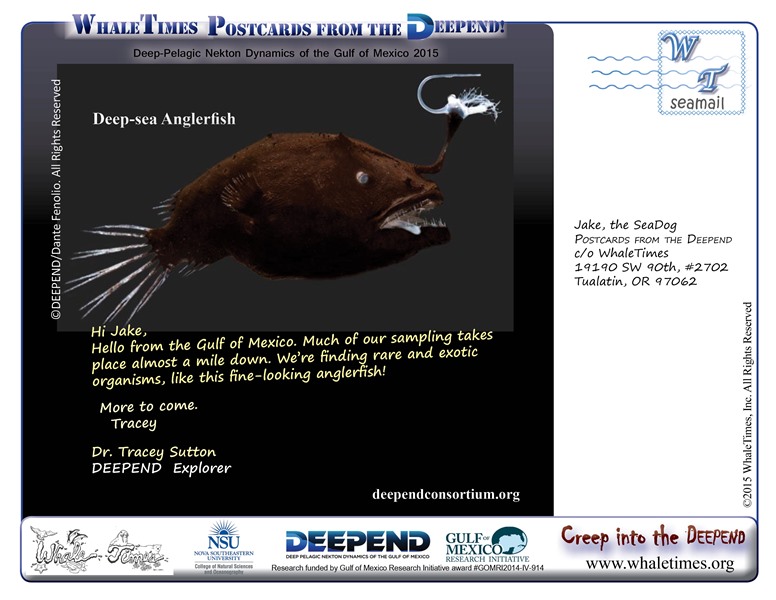
Another fantastic deep-sea fish from Team Fish, part of the DEEPEND Research team aboard the R/V Point Sur
Join WhaleTimes at the DEEPEND, no floaties required!

Another fantastic deep-sea fish from Team Fish, part of the DEEPEND Research team aboard the R/V Point Sur
Join WhaleTimes at the DEEPEND, no floaties required!
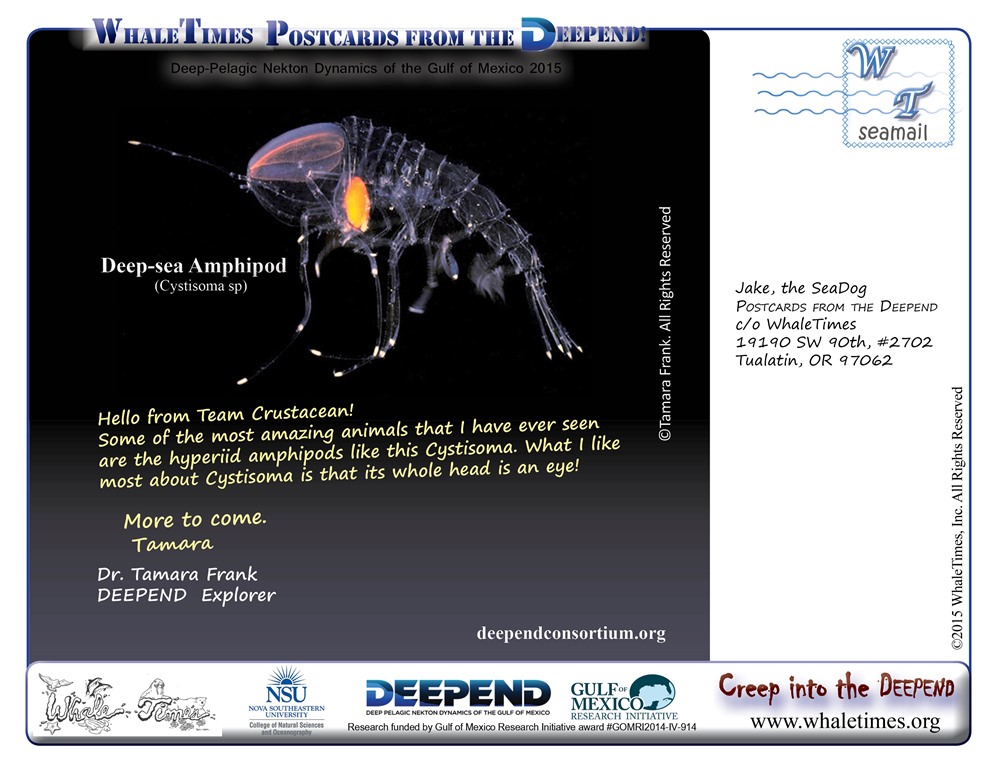
Another beauty from Team Crustacean, part of the DEEPEND Research team aboard the R/V Point Sur.
Read more Postcards from the DEEPEND
Join WhaleTimes at the DEEPEND, no floaties required!
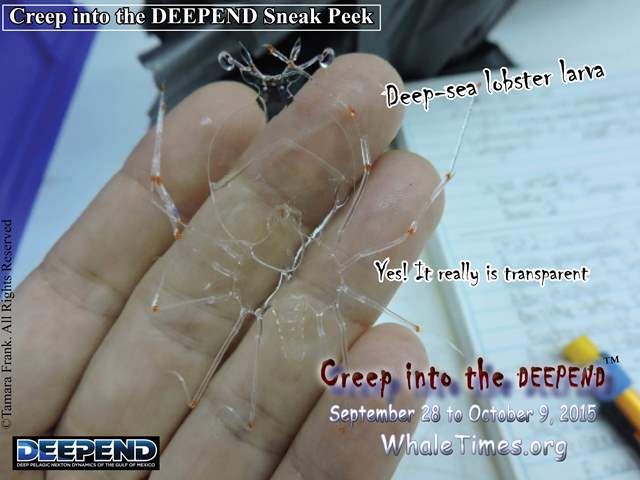
This lobster larva is just one of the many amazing creatures our Science Team will share with kids around the country during our Creep into the DEEPEND Virtual Research Mission September 28 to October 9.
Joins WhaleTimes at the DEEPEND, no floaties required!



Dear Virtual Science Team,
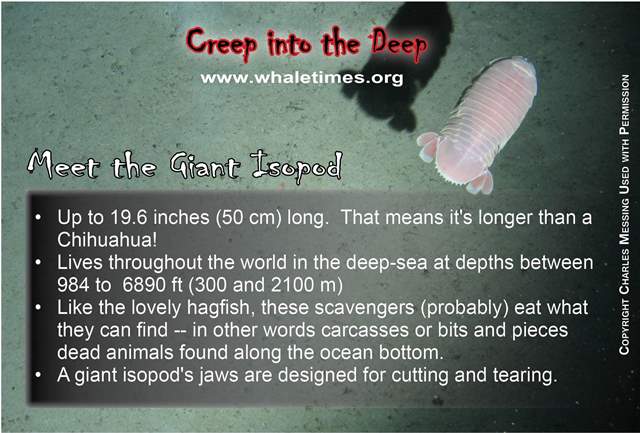 Though we hoped to see many giant isopods so we could learn more about their vision. So far they have eluded us. Maybe on the next ROV dive or maybe the Medusa secretly videoed them dancing and singing after the ROV left! Wouldn’t that cool?
Tammy
Dr. Tamara Frank
Chief Scientist and Deep-Sea Explorer
Creep into the Deep Mission:
Bioluminescence and Vision on the Deep Seafloor 2015 Expedition, NOAA-OER
Hello Virtual Science Team,
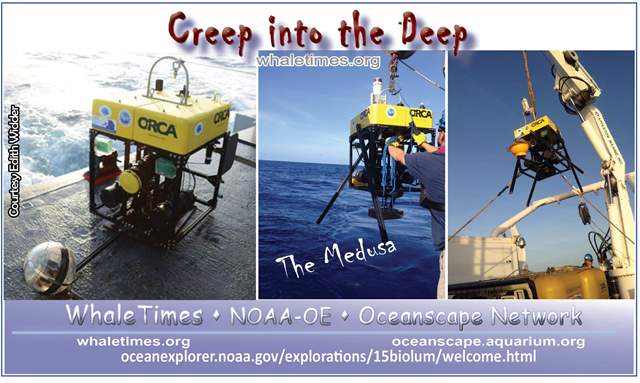 Today is the fifth day of our cruise and the Medusa is on her second drop. This is the first time for the Medusa to be in the Gulf of Mexico. The Medusa is a camera system designed to explore the deep sea in a new way – one that focuses on attracting animals instead of scaring them away. I became interested in a different way of exploring after many years of diving in submersibles and using Remote Operated Vehicles (ROVs). Both convinced me that animals were avoiding the bright lights and noisy thrusters on these standard exploration platforms.
My solution was a camera platform that was quiet and that could see without being seen by illuminating with red light that is invisible to most deep sea animals and that used an optical lure. 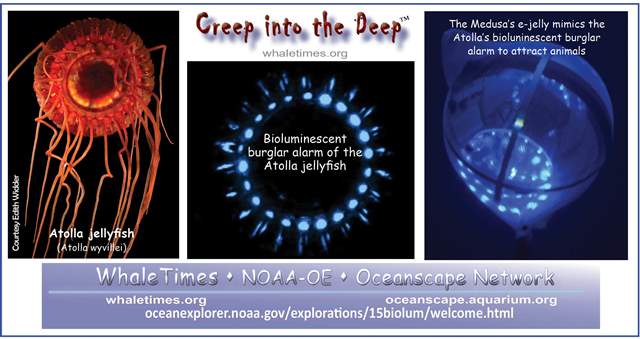 What’s an optical lure? It’s a ring of dim blue lights that imitates the bioluminescent burglar alarm display of a deep-sea jellyfish. The burglar alarm might startle the predator and entice bigger predators to swoop in for a quick meal of the would-be predator. When the e-jelly on the Medusa lights up, it lures animals closer so we can capture them on video.
It has been remarkably successful and has recorded some amazing things including the first video ever recorded of a giant squid in the deep sea! We probably won’t see any giant squid on this mission but I’m always hopeful that we’ll see something completely new and exciting.
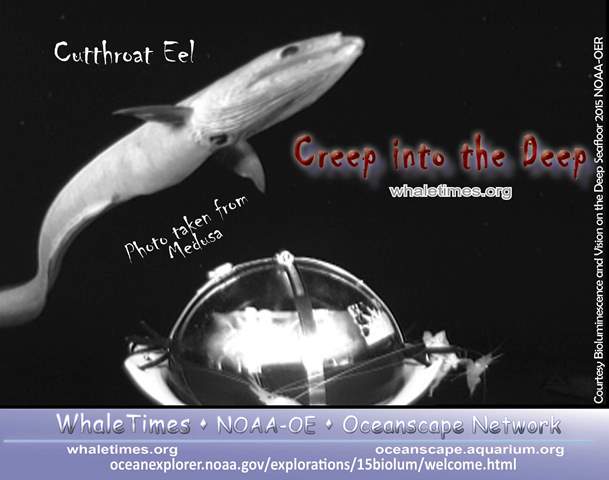 Here is a photo from its first deployment on this cruise, a very cool eel.
It’ll be exciting to find out what else the Medusa saw in the deep!
Cheers,
Edie
Dr. Edith Widder
Marine Biologist and Deep-Sea Explorer
Creep into the Deep Mission:
Bioluminescence and Vision on the Deep Seafloor 2015 Expedition, NOAA-OER
Hi Virtual Science Team,
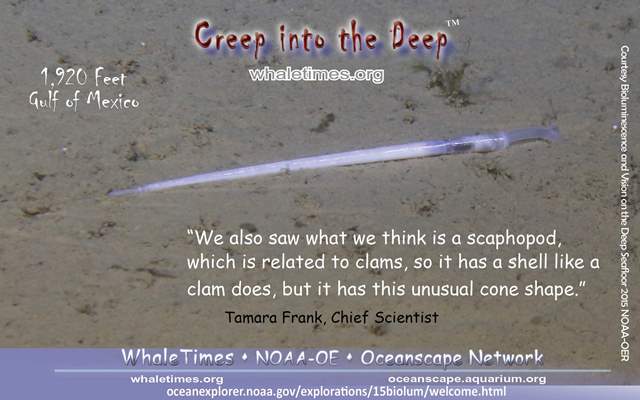 Our Global Explorer ROV happened upon this We also saw what we think is a Scaphopod. This odd-looking creature is related to a clam, so it has a shell like a clam does. But it has this unusual cone shape. Because it’s shaped like a tusk, it’s also called a tusk shell. Usually, they’re found buried in the sediment (dirt), with the narrow end up, but this little thing was moving along, dragging its huge shell behind it. We never did figure out why it didn’t like the section of mud that it was already on. I guess that’s an advantage of having your home on your back. You can pick up and move if you don’t like the neighborhood!
Tammy
Dr. Tamara Frank
Chief Scientist and Deep-Sea Explorer
Creep into the Deep Mission:
Bioluminescence and Vision on the Deep Seafloor 2015 Expedition, NOAA-OER
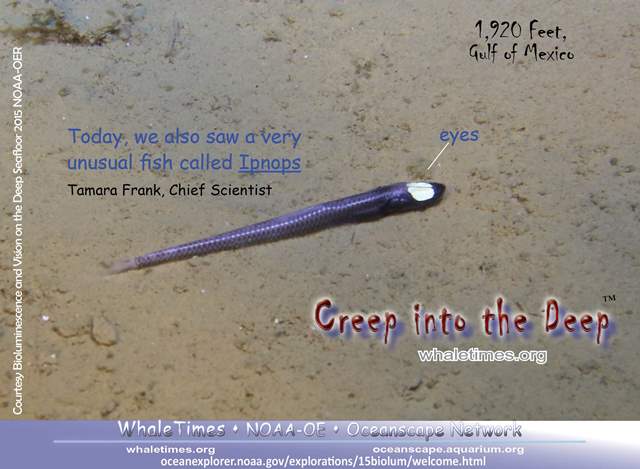 Hi Virtual Science Team,
Our Global Explorer ROV happened upon this very unusual fish called Ipnops. Those two bright yellow patches on the top of its head are its eyes. It doesn’t have lenses, because those cut out too much light. Basically, the eyes are naked retinas, with a layer of reflecting pigment below them, which is what gives it them that yellowish glow when you shine a light on it.
Tammy
Dr. Tamara Frank
Chief Scientist and Deep-Sea Explorer
Creep into the Deep Mission:
Bioluminescence and Vision on the Deep Seafloor 2015 Expedition, NOAA-OER
Dear Virtual Science Team,
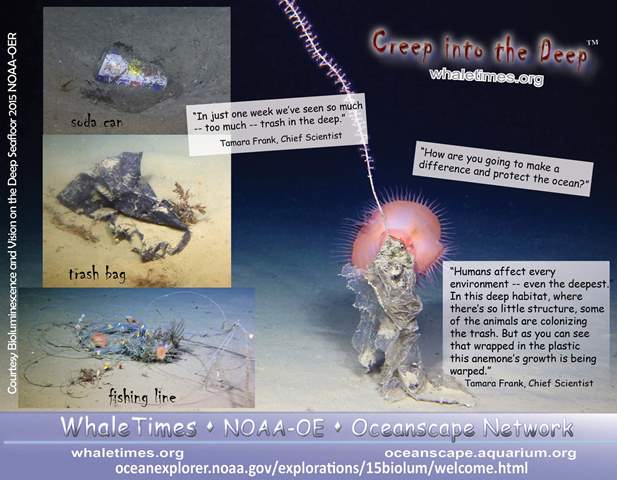 We’ve seen so many exotic and amazing creatures it makes me smile just thinking about them. As you know, the deep is a very important home to so many mysterious and marvelous animals.
Some moments, though, cause my smile to fade. At the deepest depths, we see trash. Human created garbage mars the beauty even at the great depths where we’re studying, 6,562 feet (2,000 m).
At this deepest habitat, where there’s so little structure, some of the animals try to colonize on the trash. But as you can see with the anemone wrapped in the plastic, its growth is being warped. We saw fishing line, soda cans, trash bags, and even a big oil barrel.
Now that you’ve helped us explore the deep, you have an important job. Help us keep it clean.
Many people do not realize that everything they do on land affects the deep — from not properly disposing of trash to not monitoring invisible pollutants such as chemicals like the detergents, fertilizers, cars, and other products we use all the time.
How can you help? It’s easy to make a difference. Reduce, reuse, and recycle. Be aware of the products you use that might run from your home, lawn, or driveway into storm drains an into streams and rivers. It all makes it to the ocean.
What do you think you can do to help us protect the deep sea?
Tammy
Dr. Tamara Frank
Chief Scientist and Deep-Sea Explorer
Creep into the Deep Mission:
Bioluminescence and Vision on the Deep Seafloor 2015 Expedition, NOAA-OER